
After a large weight loss on Ozempic, Wegovy, Mounjaro, or Zepbound, the abdomen is rarely one problem. It is usually a mix: some fat that stayed, some skin that emptied out and did not shrink back, and sometimes a muscle wall that is not holding things in as it used to. In the mirror they blur together. On an exam they are three separate layers, and each one has a different fix.
Getting that sorted out first is the difference between a plan that works and an operation that disappoints. Here is how to read your own abdomen, what liposuction and a tummy tuck each actually change, and the layer that surprises people most.
Three layers, three different problems
Skin. Skin stretches to hold the fat under it. When the fat leaves, the skin has to retract, and how well it does depends on your age, genetics, how long it was stretched, sun exposure, smoking history, and how fast the loss happened. Skin that cannot retract hangs, folds, or looks creased. Stretch marks are small tears in the deeper skin layer and do not tighten on their own.
Subcutaneous fat. This is the layer between the skin and the muscle, the part you can pinch. It is the fat liposuction removes.
Visceral fat and the abdominal wall. Deeper than the muscle sits fat around the organs, and the muscle itself can be stretched or separated down the middle, a condition called diastasis recti, which is common after pregnancy and after large weight changes. Either can make the belly push forward even when the skin and the pinchable fat are modest.
A few ways to check at home
None of these replaces an exam, but they point you in the right direction.
- The pinch. Pinch the skin on the lower abdomen. A thick roll that you can hold means subcutaneous fat. A thin, loose fold that feels like fabric is mostly skin.
- The lean. Bend forward at the waist. Skin that drops into a hanging apron or fold is skin excess. A firm bulge that stays put is more likely fat or the abdominal wall.
- The lie-down. Lie on your back with your knees bent. If the belly flattens a lot, the protrusion was skin and soft tissue. If it stays rounded and firm, it may be visceral fat or muscle separation. Raising your head and shoulders slightly can show a ridge down the middle if there is diastasis.
- The fold on the lap. If skin rests on your thighs when you sit, or you get rashes or irritation in the crease, that is a skin problem, not a fat problem.
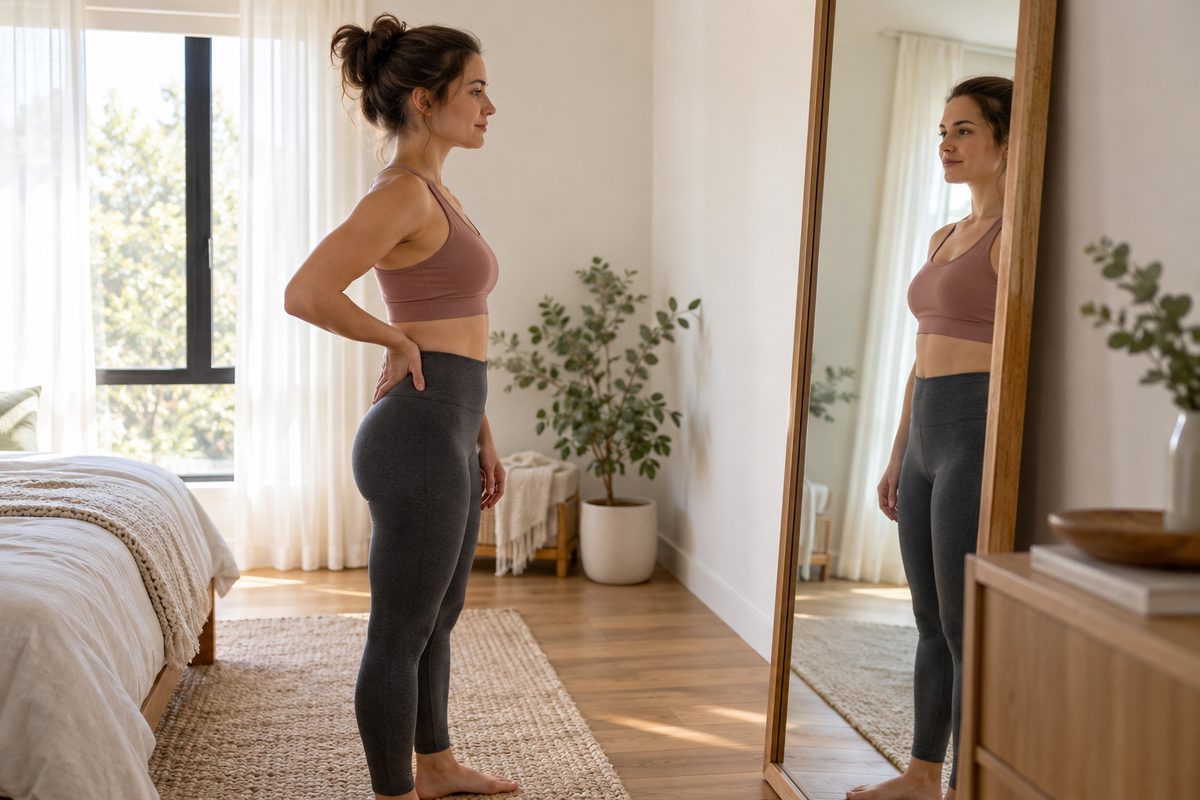
Leggings, shapewear, and morning bloating all change the outline. GLP-1 medications can also cause bloating and constipation in some people, so the belly can look different from day to day. A surgeon examines you standing, sitting, and leaning, without the garment.
What liposuction does, and where it stops
Liposuction removes subcutaneous fat through small incisions, using thin cannulas. It suits someone whose skin is still reasonably elastic and whose problem is a pocket of fat at the waist, the flanks, the lower abdomen, the back, or the hips. It also sculpts, because the surgeon chooses where to take more and where to take less.
It has limits that matter after weight loss:
- It does not remove skin. After fat is removed, the skin has to retract on its own. If it is already loose, taking out the fat under it can make the looseness more visible.
- It cannot reach visceral fat. That fat sits under the muscle, out of range.
- It does not fix a separated abdominal wall.
- It is not weight loss. Surgeons limit how much fat is removed in a session for safety, and the volume is a medical decision made at the visit.
Swelling is part of recovery. A compression garment is commonly used, and the final shape takes weeks to months to settle. If you regain weight later, it tends to go to areas that were not treated, which can change your proportions. The liposuction page covers the procedure at this practice.
What a tummy tuck does
An abdominoplasty removes excess abdominal skin and fat and, where needed, tightens the muscle wall with stitches. It is the operation that addresses a hanging apron, a lower belly that folds, and a separated abdominal wall. The belly button is repositioned through the tightened skin, and the scar sits low, where it can usually be covered by underwear or a bikini, though its length depends on how much skin is removed.
Surgeons describe a spectrum:
- Mini tummy tuck: a shorter incision, working on the area below the belly button. It suits a small amount of excess skin in the lower abdomen.
- Full tummy tuck: removes skin and fat above and below the belly button and repairs the muscle wall. This is the usual choice after significant weight loss.
- Extended or circumferential approaches: when the looseness wraps around the flanks and back, the plan may widen to include them, sometimes as a lower body lift.
Which one fits depends on where your skin excess sits, not on a name. Recovery involves drains for some patients, a compression garment, limits on lifting and bending, and a period of walking bent forward before the skin relaxes. Risks include fluid collections, wound healing problems, infection, blood clots, scar widening, and numbness, and results vary. This article covers who the operation fits after a GLP-1 drug, and the tummy tuck page covers the procedure itself.
Panniculectomy: a different operation with a different purpose
You may hear the word panniculectomy. It removes the hanging apron of skin and fat that drops below the pubic area, and it is designed to treat the problems that apron causes, such as rashes, skin breakdown, and infection. It does not tighten the abdominal wall or reshape the waist, so it is not a cosmetic tummy tuck. Plans that cover it commonly ask for photographs and documentation of recurring rashes, infections, or skin breakdown under the fold that did not clear after about three months of treatment, plus a documented period of stable weight, often six months. Cosmetic tummy tucks and muscle repair are generally not covered. The American Society of Plastic Surgeons publishes recommended coverage criteria along these lines, but each plan sets its own, so ask your insurer what they require before you assume either way.
When people need both
Plenty of people do. A common plan is liposuction in areas where the skin can handle it, together with a tummy tuck where it cannot. Some surgeons combine them in one operation, and others stage them, depending on how much needs to be done and how safe a single long operation would be for you. That is a conversation for the visit, and the order of operations is a surgeon's call rather than a menu option.
What does not work as a substitute
- Exercise builds muscle under the skin. That can improve the contour, but it does not remove a fold of skin. People who train hard and still see the fold are looking at skin, not a lack of effort.
- Creams do not remove excess skin. Moisturizers help with how skin feels, and some ingredients may help skin quality at the margins, but nothing topical shrinks a hanging fold.
- Waist trainers change how clothes fit while you wear them and do nothing once they are off.
- Energy-based skin tightening (radiofrequency, ultrasound, and similar treatments) can produce modest tightening in mild laxity. It is unlikely to resolve significant looseness after a large loss. If a clinic suggests it, ask for realistic expectations and whether your skin is a candidate.
What recovery looks like for each
Liposuction. Expect soreness, swelling, and bruising in the treated areas, a compression garment for a few weeks, and walking from the first day. Many people return to desk work within days to a couple of weeks, depending on how much was done. Swelling and firmness can persist for weeks, and the final contour takes months to appear. Risks include contour irregularities, asymmetry, fluid collections, numbness, infection, and, rarely, more serious complications. Skin that does not retract can look looser than before.
Tummy tuck. Recovery is longer and more restrictive, with limits on lifting, bending, and exercise for several weeks. The walking posture, the garment, and the drains if used are all part of the first weeks. The scar takes a year or more to mature. A longer surgery brings additional risks, including blood clots, which is why your health and your medications are reviewed carefully.
Questions to ask at the consultation
- Which layer do you think is causing my abdomen to look this way: skin, fat, muscle, or something deeper?
- Would liposuction alone help, or would it make the looseness worse?
- Do I have diastasis, and would it be repaired?
- If you recommend a tummy tuck, which type, and where will the scar sit?
- Do you suggest combining procedures or staging them, and why?
- How will my weight and my medication affect timing?
- What do the quote and the facility include?
Be cautious about any office that quotes a specific operation from a single photo, or that promises a flat stomach without examining you. Before and after photos are worth looking at, but a result on someone with different skin, age, and weight history is not a forecast of yours.
Common questions
Will my skin tighten if I give it more time?
Some retraction continues for several months after weight stabilizes, which is one reason surgeons want a stable weight before operating. Significant loose skin after a large loss usually does not resolve fully on its own.
What if only the lower belly bothers me?
Say that clearly. A mini tummy tuck or targeted liposuction may fit a smaller concern. The upper abdomen, the flanks, and the lower fold are not always the same problem, and treating only one can leave the rest looking out of place.
Can I have liposuction first and decide on a tummy tuck later?
Sometimes, but you may lose some of the information the surgeon needs, and a later tuck is planned around what the first operation changed. Discuss the sequence before starting.
I lost weight and my stomach still sticks out. Why?
The cause could be visceral fat, a separated abdominal wall, bloating, or retained fat in the abdominal layer. Only an exam sorts these out, and the answer changes which operation, if any, is appropriate.
This article is general information, not medical advice. Whether liposuction, a tummy tuck, or neither fits you is decided by a surgeon after an exam. Every surgery carries risks, and results vary.
The images in this article are illustrative and AI-generated. They are not patient photos and do not show results.
Sources
- American Society of Plastic Surgeons, Recommended Insurance Coverage Criteria: Surgical Treatment of Skin Redundancy for Obese and Massive Weight Loss Patients
- American Society of Plastic Surgeons, Practice Parameter for Surgical Treatment of Skin Redundancy
Related reading: What a Tummy Tuck Is For After GLP-1 Weight Loss · How Long After Ozempic Should You Wait for Plastic Surgery? · After Ozempic, Which Procedures Should Wait?