• Financing

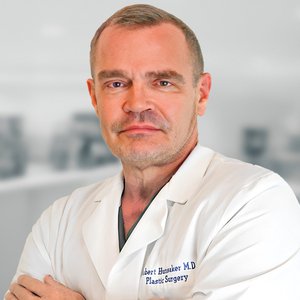
ROBERT HUNSAKER, MD, FACS

Over the past 25 years, widely respected reputation due to his surgical judgment and superb technical skills.

 | 

Robert Hunsaker Plastic Surgeon at CG Cosmetic 

Credentials: Board-certified by the American Board of Plastic Surgery. Florida medical license ME51546. Verify at the Florida DOH license lookup.


Dr. Robert H. Hunsaker is board certified by the American Board of Plastic Surgery, specializing in cosmetic plastic surgery of the face and body, whether you want something like breast augmentation, or an in-depth understanding of facelift surgery, the caring and helpful environment will undoubtedly aide you in making the right decision. Dr. Hunsaker was elected a fellow of the prestigious Fellowship of the American College of Surgeons. He has been involved in research involving diseases of heart muscle, microvascular surgery, developing improved breast implants, and improved techniques for facelifting.

Dr. Hunsaker has published multiple research papers and has been a guest on many television and radio programs. He has also been invited to speak to plastic surgeons around the globe from Japan to Bahrain, England to South America. He has served patients from 32 countries and all 50 states and is a member of many local, regional, and national medical and plastic surgery organizations.

While Dr. Hunsaker does maintain operating privileges at Kendall Regional Hospital, for the convenience and finances of his patients, most surgeries are performed at CG Cosmetic Surgery in our fully licensed/accredited surgical facility.

Procedures Dr. Hunsaker performs at CG Cosmetic

Dr. Hunsaker performs these procedures at CG Cosmetic Surgery in Miami. Each link opens that procedure's page.

ABOUT DR HUNSAKER

Robert Hunsaker Miami

CG Cosmetic Surgery surgeons are some of the most experienced, skilled and highly qualified in the industry. Watch the video to learn more about Dr. Hunsaker and what makes him stand out from the rest.   

Education And Training


  • Wittenberg University – (Honors)
  • Ohio State University College of Medicine (Honors)
  • University of North Carolina – Five-year general surgery residency, Chief Resident
  • City Hospital Regional Plastics Unit, Nottingham, England – 18-month special plastics fellowship
  • University of Miami School of Medicine – Plastic surgery residency under world-renowned plastic surgeon, Ralph Millard, Jr. M.D., Chief Resident
  • Former Associate Chief Plastic Surgery, University of Miami
  • Former Director, Plastic Surgery Residency Training Program, JMH/University of Miami

DON'T KNOW WHERE TO START OR WHICH SURGEON TO CHOOSE?

Don't worry you are not alone, give us a call to schedule your initial consultation and one of our trained care coordinators will be able to assist you!

305 446-7277 | Request Callback

Our surgeons answer your questions

How many CCs do you need for breast implants?

With Dr. Robert Hunsaker

Implant choice is about dimensions, not volume: two 600 cc implants can look completely different depending on width and profile. Dr. Hunsaker also explains teardrop vs. round implants and why goal photos work better than a cc number.

Read the transcript

Dr. Hunsaker, a lot of patients message us on Instagram asking how many CCs they should get. What do you usually say? My first answer is that it's not a volume operation, it's a dimensional operation. The number of CCs is secondary, even tertiary, in our consideration. What's important is the dimensions; then we choose a profile, and however many CCs that is, is what we use. When I'm with a patient, I show them implants and how dramatically different they can be depending on the dimensions, even with the same volume. If I say you should have 600 CCs: would you want this 600 cc or this 600 cc? Held sideways, there's a tremendous difference in projection and a huge difference in diameter, but they're the same volume. The wide, low-profile implant suits someone who already has a wide chest, which is more common in taller people, a fair amount of existing breast tissue, and who wants only a modest increase. If a 5'10" patient wants the look a 5'3" patient got, she may need that width with more projection, so far more than 600 CCs. Sometimes silicone only goes to about 800 cc and the patient needs 900 or 1,100, so we use saline implants, which can be overfilled to reach a greater volume on that base width. Patients often compare themselves with a friend who got 300 CCs, but the friend may have a completely different frame and different starting breast tissue. Someone very flat needs more projection, and therefore more volume, than someone with the same build who starts with a B cup. What's the difference between a teardrop implant and a round one? The teardrop, or contoured, implant is pre-shaped. Patients often think it gives a more natural result, but when a round implant is upright in the body it also takes a teardrop shape. Teardrop implants have to be oriented exactly vertically, so they have a somewhat higher re-operation rate, and large studies show you really can't tell the difference in the cosmetic result. How many CCs for a natural look? Everybody's idea of natural is different. The smaller you go, the less fake it looks; the bigger you go, the more fake it looks. The more of your own tissue and body fat you have covering the implant, the harder it is to get a fake look. That's why I communicate through pictures: patients show me what proportion they want to see in the mirror from belly button to collarbone six months or a year after surgery. You won't decide if you're happy based on bra size or CCs; you'll look in the mirror.
Why do extra-large breast implants cost more?

With Dr. Robert Hunsaker

Extra-large implants put much more stress on the overlying tissues. They need more technique and judgment and carry a higher complication rate, which is why the procedure costs more than a standard augmentation.

Read the transcript

Hi, I'm Dr. Hunsaker, one of the board-certified plastic surgeons here at CG Cosmetic. Patients sometimes ask why an extra-large breast augmentation costs more than a standard breast augmentation. You need to understand that an extra-large breast augmentation places a tremendous amount of stress on the overlying tissues. It requires not only better technique, but a great deal of judgment in how full to make it before you stop, how much to stress the tissues. Because of this higher complication rate and the greater degree of skill and experience necessary to achieve predictable good results, the cost is somewhat higher. If you have other questions about this procedure, please call the office and one of the coordinators will be happy to answer all your questions.

Can you close the gap between your breasts?

With Dr. Robert Hunsaker

The space between the breasts depends partly on anatomy and partly on how far the surgeon dissects toward the breastbone. Implants that sit too close together can be repositioned with a revision, often using mesh support.

Read the transcript

Dr. Hunsaker, one question that we get often is about the gap in between the breasts that some women have. How do you address the gap, and how can you close the gap, or open it in some cases when women request it? It's a common question that they ask. I want to get them closer together. Sometimes they're further apart. It's partly the anatomy but partly what we do. But once I've actually examined them, I can give them the feedback about what they can expect. Occasionally someone says they don't want them very close, and the part we can control is how far we dissect under the muscle toward the breastbone. If somebody has implants that are too close together, then we have surgery we can do, usually using some sort of mesh like GalaFLEX to recreate the middle border, to reset the position of the implant.

Breast augmentation for trans patients: what changes?

With Dr. Robert Hunsaker

How much breast development hormone therapy has produced changes the plan: with little development the nipple sits closer to the fold under the breast, which the surgeon has to account for when choosing implant position.

Read the transcript

If you look at a genetic male breast, the nipple position is much, much closer to the inframammary fold. And so if there hasn't been really any meaningful breast development from their hormone therapy, that has to be taken into consideration. That distance does stretch a little bit over time. That nipple isn't actually sitting up in the middle of the breast mound. Now if they have reasonable breast development from their hormone therapy, that distance is already stretched, and it's less of a consideration for sure.

Breast augmentation recovery: what to expect

With Dr. Robert Hunsaker

Recovery happens in phases: pressure on the chest for the first few hours, mild discomfort by the next day, no heavy lifting, pushing or pulling for at least three weeks, no driving for at least five to seven days, and a return to desk work as soon as you feel comfortable.

Read the transcript

The recovery from breast augmentation happens in phases, really. There's a super early phase, for the first few hours after surgery, where for the majority of patients there's a great deal of pressure on the chest. People liken it to when the breasts get engorged the first time they start breastfeeding, which apparently is extremely uncomfortable pressure. It starts to ease off during the day, and typically by the next day you just have some mild discomfort. Now, there's restriction of activities for a little while: no heavy lifting, pushing, pulling or strenuous activity. That's to avoid elevations in blood pressure, because one of the risks after surgery is post-operative bleeding around the implant, which typically requires an unplanned return to the operating room, which nobody wants. That's why we have those restrictions in place. In addition, you really shouldn't be driving for five to seven days, at least. In terms of returning to vigorous activities in the gym, you could start doing walking and that sort of thing after seven to ten days. But in terms of heavy weight lifting and things like that, you really should wait a minimum of three weeks. Some patients might want to wait a little longer. In terms of returning to your normal day-to-day activities, it's not where you are, it's what you're doing. So if you work from home on a computer and don't have to drive to work, as soon as you're comfortable, you can return to work.

How big can breast implants go?

With Dr. Robert Hunsaker

The limits are mostly anatomy: how wide the breast is, how far it is from the inframammary fold to the upper limit of the implant space, and how elastic the skin envelope is. The implant needs space, and the incision has to close without too much tension.

Read the transcript

There are a number of factors that play into how big we can go with a breast implant. A patient may come in and say, I want to be as big as I can possibly be. But there are limits, and they're mostly related to anatomy. One super important factor is how wide the breast is; we measure that. Another is how far it is from the inframammary fold to the upper limit of where we have space to put an implant. Some people are pretty short in that distance, and that really limits it. Other people are quite long; they have what we call a long torso. Another super important part is the elasticity, or tightness, of what we call the skin envelope. All of these things factor into being able to safely put an implant in. There has to be space for it, and you have to be able to close the incision without too much tension. That takes experience, judgment and some measurements to help us make that decision.

Do breast implants need to be replaced every 10 years?

With Dr. Robert Hunsaker

There is no fixed replacement schedule. Implants are mechanical devices that can last a very long time but should not be expected to last a lifetime. A saline leak is obvious because the implant deflates; for silicone gel implants, an MRI or high-definition ultrasound is recommended in the first five or six years and every two to three years after.

Read the transcript

Very commonly, people hear that you have to change your implants every 10 years, as if there were some sort of maintenance schedule, and there isn't. Breast implants are mechanical devices. All mechanical devices have a certain failure rate. They can last a long, long time, but you shouldn't expect them to be lifetime implants. In some cases they are, but that should not be your expectation. If you have saline implants, it becomes very obvious if you have a leak or a problem, because the implant deflates, and it's not subtle. There's really no specific monitoring: if the implant is doing well, you know everything is intact and doing fine. Silicone gel implants are a bit different. What's recommended is that in the first five or six years you get either an MRI or a high-definition ultrasound to check the integrity of the implant, and then you check it every two to three years after.

Our Physicians Team

Experience the mastery of our top-tier Miami plastic surgeons. As a team of highly skilled, proficient professionals, we provide a broad spectrum of specialized cosmetic procedures. Our surgeons are experts in performing breast augmentation, Brazilian butt lift, breast lift, tummy tuck, and rhinoplasty. Our goal is to enhance not only your physical appearance but also your self-confidence and overall wellness. We specialize in augmenting the breast size and shape, refining the contour of the buttocks, rejuvenating facial youthfulness, and sculpting the abdomen. Trust our plastic surgeons to deliver stunning, natural-looking results, elevating both your body's aesthetics and your peace of mind.