
Breasts change in two ways after a large weight loss. They sit lower, and they look emptier. Ozempic, Wegovy, Mounjaro, and Zepbound did not invent that pattern, since a big loss from any cause can do it. The drugs are simply how many people are losing weight now, which is why more of them are asking whether they need a lift, implants, or both.
The answer depends on which of the two changes bothers you most, and how much each one has happened. This article walks through how to tell, what each operation does, what happens when they are combined, and what to know about risks and long-term care.
Why the breasts change
Breasts are made of glandular tissue and fat, held in a skin envelope. Much of the volume in many women is fat. When overall body fat falls, breast volume often falls with it, and the skin that used to be filled by that volume stays stretched. The result is usually a combination of deflation (less volume), ptosis (the breast and nipple sitting lower), and stretched, thin skin.
How much it changes depends on how much you lost, how large your breasts were to begin with, your age, skin quality, pregnancy and breastfeeding history, and genetics. Asymmetry is common, and it often becomes more noticeable after a loss.
A quick way to see which problem you have
Stand in front of a mirror without a bra and look at two things.
- Where the nipple sits compared with the crease under the breast (the inframammary fold). If the nipple is at or below the fold, or points downward, the breast has dropped. A lift addresses that.
- How full the upper part of the breast looks. A flat or hollow upper slope, with most of the tissue sitting low, points to lost volume. Implants or fat address that.
Surgeons grade drooping from mild to severe by that nipple-to-fold relationship. There is also a situation sometimes called pseudoptosis, where the nipple is still above the fold but the breast tissue has slid below it, and that can be handled differently from a true drop.
When the issue is position: a breast lift
A breast lift (mastopexy) removes excess skin, reshapes the tissue, and raises the nipple and areola to a more natural position on the front of the breast. Depending on how much drop and how much extra skin you have, the incision may go around the areola, around the areola and down to the fold, or along the fold as well (the anchor pattern). More lift generally means more scarring.
A lift does not put volume back. In fact, because skin is removed, a lift can make the breast slightly smaller. Someone who is happy with a smaller size and wants the nipple higher and the breast firmer may need only a lift. The breast lift page describes the operation at this practice.
When the issue is volume: implants
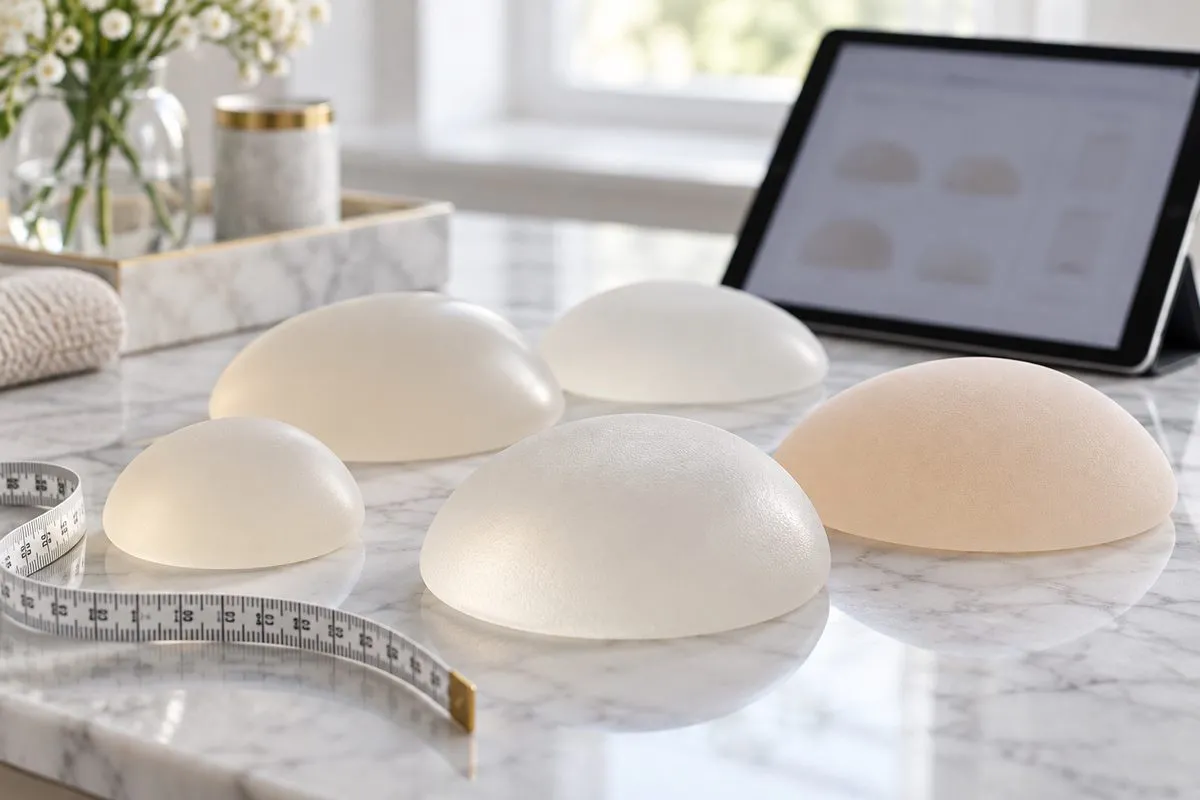
Implants add fullness. They suit the person whose breast looks deflated and who wants more upper-pole fill. The choices include saline or silicone, round or shaped, different widths and projections, and placement above or below the chest muscle. Those decisions are made with your surgeon based on your chest width, tissue thickness, and the look you want.
After a large weight loss, there is a particular consideration. Thin, loose skin and less natural tissue can leave less cover over an implant, so edges and rippling can show more. An implant also does not reliably lift a nipple that already points down. Adding size to a breast that sits too low can make the sag look heavier. Implant options are on the breast augmentation page.
Fat transfer to the breast is another way to add a modest amount of volume, but it needs donor fat, which is often in short supply after a big loss.
When you need both
When the nipple has dropped and the breast is also empty, a lift and an implant together address both. The lift sets position and removes extra skin. The implant provides the fill.
Some surgeons do both in a single operation, and others stage them into two. Combining them adds complexity, because the implant is trying to fill the breast while the lift is tightening the skin around it, and the evidence is mixed. A systematic review of single-stage procedures reported a pooled reoperation rate of about 11 percent, and a large analysis of surgery center data found secondary breast surgery somewhat more common after the combined operation (about 6 percent) than after augmentation alone (about 4 percent) or a lift alone (about 5 percent), though the gap was smaller than earlier reports suggested. Whether to stage is a safety and results decision for your surgeon, not a default package. Either way, the plan should be explained to you before you commit.
What the recovery looks like
- First days: soreness and swelling, a surgical bra, and limits on arm movement and lifting. Drains are used in some cases.
- Weeks one to two: many people return to desk work, with no heavy lifting or strenuous activity.
- Weeks four to six: exercise returns gradually as your surgeon clears it.
- Months: breasts settle into position over weeks to months, and scars fade over a year or more.
Risks to understand
For any breast surgery: bleeding, infection, asymmetry, changes in nipple or breast sensation, and scars that widen or thicken. With a lift, there is also a risk of problems with nipple healing, and a small risk that the nipple loses some or all of its blood supply. With implants, long-term issues include capsular contracture (the scar tissue around the implant tightening), rupture, rippling, and the need for replacement or removal over time. The FDA states that implants are not lifetime devices, and recommends periodic imaging for silicone implants, with the first scan five to six years after surgery and then every two to three years. Breast implant associated lymphoma (BIA-ALCL), a rare cancer, has been linked mostly to textured implants. Your surgeon should discuss which type is being used and why.
Surgery on the breast can affect breastfeeding, so tell your surgeon if you plan to have children.
Scars, which people often underestimate
A lift always leaves scars, and they are longer than the scars of an implant-only operation. The degree of drooping decides the pattern. A mild lift may leave only a scar around the areola. A moderate lift adds a vertical line from the areola to the fold. A large lift adds a horizontal scar along the fold. Scars are red and firm at first, and usually soften and fade over a year or more, though how they heal depends on your skin and varies from person to person. Ask to see healed examples at your surgeon's practice, with the understanding that your own result will be your own.
Questions to ask at the consultation
- Do I need a lift, implants, or both, and why?
- Which lift pattern do you recommend, and where will my scars be?
- Would you stage the operations or do them together? What is your revision rate for each approach?
- If implants, which type, size, and placement, and why for my tissue?
- What happens if my weight changes again?
- What follow-up and imaging do you recommend for implants over the years?
- What does the written quote include, and what happens if I need a revision?
Practical points people overlook
- Cup size is not a measurement of volume. Bring photos of breast shapes you like and ask the surgeon to show you sizers or simulations.
- Weight changes will move them again. A regain or further loss changes breast volume. That is part of why surgeons want a stable weight first.
- Screening continues. Mammograms and breast exams still apply, and you should tell the imaging center about implants.
- One side is often different. Say so. The plan can adjust for it, but it will not make the two breasts identical.

Common questions
Will my breasts fill back in if I gain a little weight?
A small regain does not reliably restore a breast that deflated after a large loss. Gaining weight to avoid surgery usually shows up elsewhere first.
Do I have to decide on implants at the first visit?
No. The first visit should separate position from volume. You can leave knowing which problem you have and decide later.
Is this different from a lift for aging or pregnancy?
The operation can be the same. The starting point is different, and weight loss breasts are often emptier. This article focuses on the loss.
Can this be combined with a tummy tuck?
Sometimes. Whether it is safe depends on the length of the combined operations and your health. The article on which procedures should wait explains how that decision is made.
This article is general information, not medical advice. The right operation for you is decided by a surgeon after an exam. Every surgery carries risks, and results vary.
The images in this article are illustrative and AI-generated. They are not patient photos and do not show results.
Sources
- U.S. Food and Drug Administration, Breast Implants: Certain Labeling Recommendations to Improve Patient Communication
- U.S. Food and Drug Administration, Questions and Answers about Breast Implant-Associated Anaplastic Large Cell Lymphoma (BIA-ALCL)
- Khavanin et al., A systematic review of single-stage augmentation-mastopexy (Plastic and Reconstructive Surgery, 2015)
Related reading: How Long After Ozempic Should You Wait for Plastic Surgery? · Mommy Makeover or Surgery After Ozempic? · After Ozempic, Which Procedures Should Wait?